John Quincy Adams by Fred Kaplan
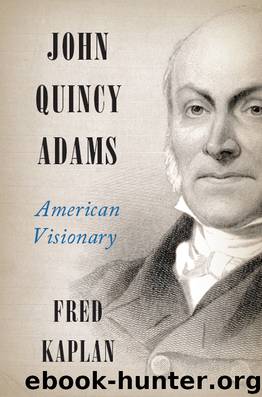
Author:Fred Kaplan
Language: eng
Format: epub
Publisher: HarperCollins
The statement to Onís and the letter to Erving were widely circulated. Jefferson enthusiastically complimented their author. “They are without exception,” he wrote to Adams and the president, “the ablest State papers he ever read.”
Despite Onís’ claim that the Florida incursion had set back treaty negotiations, the Spanish minister and the secretary of state knew that it only gave further emphasis to Spanish vulnerability. Within months, they were bargaining again, though with little progress beyond Onís’ statement that the United States could have Florida for practically nothing if it were to agree to the Mississippi as the western border of the Louisiana territory. Attempting to take the high moral ground, he continued to express outrage at Jackson’s actions. Frustrated with Spain’s unacceptable demands, Adams devoted much of his energy in late 1818 and early 1819 to repeating with blunt clarity the American position. To each of Onís’ concessions, offering a border slightly farther west, Adams said no. The United States required that the border be as close as possible to Mexico—the target was the Rio Grande—as far west as possible in the Southwest, along the north-south axis of the Great Plains, and then westward to the Pacific.
Early in 1819, the administration made a final take-it-or-leave-it offer. It would agree to a southwestern border at the Sabine River, the boundary between the state of Louisiana and Texas, rather than at the Rio Grande, if Spain would agree to American terms on every other matter. It was a political gamble. Many Americans had set their hearts on Texas. When Adams, at Monroe’s request, had two discussions with Jackson in which he previewed the treaty’s provisions, Jackson remarked that the enemies of the administration would object to the Sabine rather than the Rio Grande. But “the vast majority of the Nation would be satisfied, with the Western boundary . . . if we obtain the Floridas.” Jackson gave no hint that he was among those who would be dissatisfied.
If he could have continued negotiating, Adams believed he might have gotten a boundary even closer to the Rio Grande. But “we are now approaching so near to an agreement that the President inclines to give up all that remains in contest.” Onís hoped for some minor adjustments in Spain’s favor. On the morning of February 20, 1819, he called on Adams at home. He would accept the treaty as is, he conceded, including the provision that all land grants made after January 24 were void, though he still thought the United States should make two minor concessions. Adams was not in a conceding frame of mind. “I observed there was no time left for further discussion; and we had yielded so much that he would have great cause to commend himself to his court for what he had obtained. He said I was harder to deal with than the President.” The next morning Adams went to his office for the first time ever on a Sunday. He encountered an old friend who remarked how unusual that was.
Download
This site does not store any files on its server. We only index and link to content provided by other sites. Please contact the content providers to delete copyright contents if any and email us, we'll remove relevant links or contents immediately.
Waking Up in Heaven: A True Story of Brokenness, Heaven, and Life Again by McVea Crystal & Tresniowski Alex(37815)
Empire of the Sikhs by Patwant Singh(23090)
We're Going to Need More Wine by Gabrielle Union(19055)
Hans Sturm: A Soldier's Odyssey on the Eastern Front by Gordon Williamson(18596)
Leonardo da Vinci by Walter Isaacson(13342)
The Radium Girls by Kate Moore(12036)
Tools of Titans by Timothy Ferriss(8403)
Educated by Tara Westover(8061)
How to Be a Bawse: A Guide to Conquering Life by Lilly Singh(7495)
Permanent Record by Edward Snowden(5852)
The Last Black Unicorn by Tiffany Haddish(5643)
The Rise and Fall of Senator Joe McCarthy by James Cross Giblin(5284)
Promise Me, Dad by Joe Biden(5157)
The Wind in My Hair by Masih Alinejad(5104)
A Higher Loyalty: Truth, Lies, and Leadership by James Comey(4967)
The Crown by Robert Lacey(4821)
The Iron Duke by The Iron Duke(4367)
Joan of Arc by Mary Gordon(4119)
Stalin by Stephen Kotkin(3973)
